Unless you've been under a rock, you are probably aware that Harold Camping, 89 year old California evangelical broadcaster, made a second attempt to call the end of the world at 6PM local time everywhere, beginning in New Zealand. It was sort of a rolling Judgement Day. The Apocalypse is running late.
Elsewhere in world news, Venezuela made a first by suspending a driver's license for 12 months. Ramon Parra, 41, was arrested for driving an overloaded bus with a missing rear wheel. Gas costs 12 cents a gallon in Venezuela and they take driving rights very seriously. This is the first license suspension ever for this OPEC country.
We've moved even further east to Moab. It's a very busy place in the Spring. I lost in tennis to Mrs. Phred 6-3, 6-2. I no longer feel short of breath when she runs me around the court. It's surprising how my breathing has improved since I quit smoking. What was I thinking the last 55 years?
There are two lovely National Parks here. One is Arches. The other is Canyonlands.
The Colorado River tuns though here, creating many recreational opportunities: camping, rock climbing, jeeping in the back country, rafting, canoeing and canyoneering. I don't exactly know what the last one is, but it's advertised everywhere.
The rains are finally bringing out the prickly pear flowers.
The jury is still out on that one, but my own sample of three horses resulted in one horse asking for more and two horses spitting them out. I was out of apples. These horses are in a pasture behind our RV.
We went up to Arches again last night for some sunset shots. It was a choice between that and "Ironman". The local theatre has one movie, which it presents each day at 8 PM.
We went for a six mile hike up on the mesa at Dead Horse State Park today. The trails lead around the mesa rim for views of the Colorado River canyons 2,000 feet below.
The "point" is reached by a narrow neck of land, about 30 feet wide. It was convenient to herd wild horses onto the point and then construct a short fence over the neck from juniper branches.
Horses existed in North America from at least 100,000 years ago to 10,000 years ago, when they went extinct. Mammoths, mastodons, saber-toothed cats and giant sloths disappeared along with the horses as part of the Holocene mini-extinction event. Most scientists attribute this to the arrival of the Amerindians, with climate as a possible contributing factor.
Then the Spanish reintroduced horses to North America 500 years ago and 300 years later there were herds of wild horses up on the mesa near Dead Horse Point.
So, anyway, the horses were rounded up and the good ones were sorted out from the inferior "broom-tails" (a class of range horses that are considered not worth much). Legend has it that one time the cowboys forgot to take down the fence after the round-up and the leftover horses died of thirst out on the point.
The hike was good. Lots of good overlooks, unimpressive cryptobiotic lumps, little lizards, wildflowers, warped junipers and pinion trees. If we did six miles a day, I could melt off some extra pounds.
Dead Horse is up on the same big mesa as Canyonlands National Park. Down below we can see the same road we bumped up on the jeep.
We signed up for a three-hour ranger guided hike though the "fiery furnace". It's a maze of sandstone fins, spires and box canyons with narrow openings between the sandstone formations.
You are encouraged to take this hike with a ranger. We draw Becky, the former English Professor who conducted the lecture on Edward Abbey. Becky tries to scare off those that are afraid of heights, of rock-climbing, are short of breath or who feel unable to refrain from using a bathroom for three hours. No one drops out. She spends some time explaining the ecological importance of the little bumps in the sand (Cryptobiotic soil crusts, consisting of cyanobacteria, lichens and mosses) which take 250 years to grow large enough to be visible. We try to stay on the rocks and washes where these don't grow to avoid destroying them.
An opening in the rocks has to have at least a three-foot dimension to qualify as an arch. There are about 2500 discovered arches in the park. At 95 pounds, Mrs. Phred easily sqeezes though "Crawl-Though" arch.
I felt a little like Homer Simpson when he ate too many donuts and got stuck in the waterpark tube. My belly and butt barely squeeze though.
Becky does a fine job explaining the native plants. It's spring so the desert wildflowers are everywhere. My personal favorite is the Utah Juniper. When it runs low on water it kills part of itself to save the rest. The strange twisted shapes of the half-dead, half-alive junipers are everywhere.
I keep my eyes open for the sacred datura (moonflower, thornapple, moonlily) whose ghostly, white trumpet-shaped flowers bloom only in the desert night. The moonlily carries a heavy dose of atropine, a strong vision-inducing alkaloid.
The soft sandstone sometimes forms a honeycomb pattern where acid trapped in the rock has eroded holes.
The "biscuit root" is here. It's an endangered plant that grows only in the sand worn off from this particular strata of sandstone. The arches below are called the "skull" arches. You may notice that the picture appears to be upside down. I was standing on my head when I snapped it. In retrospect it might have been easier to flip the picture over with my photo editor.
It was a bone-jarring ride on 50 miles of bedrock. It took eight hours to bump and grind over the four-wheel drive road.
We spent some time at "Thelma and Louise Point". The was the movie that ended when Thelma and Louise, persecuted for their armed robberies and for blowing up gasoline tanker truck, drove off a spectacular cliff.
At first, because the scenery is so spectacular and varied, I was disappointed, even depressed, with the pictures.
When you blow up the pictures into the full 2 gigabyte format and look at them, they begin to hint at what your eye might have seen. However, when you try to shrink the whole thing down to a 2" x 3" picture, it doesn't translate.
So it's not my fault.
Some of the roads are a single lane that runs for several miles on the edge of a thousand foot drop with a rock wall on the other side. You get a major pucker factor when you meet a dirt bike. We were lucky not to meet any more imposing oncoming traffic.
There is a climbout on a long series of switchbacks to the top of the mesa. Meeting traffic on the climb would require you to hang two wheels over the cliff. This time I screwed up my courage and did the whole drive myself instead of turning the wheel over to Mrs. Phred and closing my eyes.
Canyonlands has some great vistas that you can reach in the family station wagon. I love the back country. They have enough four-wheel trails that it takes four or five days to do a complete circuit of the park on the edge of the canyons.
Moab had a brief boom in the early 1950s due to desert uranium mining and prospecting. It currently has been expanding rapidly because of the millions of tourists who come to enjoy the Arches and Canyonlands National Parks.
The town has a lot of jeep, ATV and dirt bike rentals as well as raft trips, sky diving and bicycle tours. Mrs. Phred googled 14 beauty parlors, but the lone barber keeps leaving notes saying he's at a convention. There's a chairlift and a waterpark that seem to be out of business as well as numerous restaurants, coffee shops, auto parts stores and bookstores. Moab is still too small for a Wal-Mart. That might be one necessary criteria for our next home.
We took a ride yesterday along a road on the Colorado river and up to the snowline in the mountains and saw dozens of really nice camping/recreation areas built along the river by the U.S. Forest Service.
This morning, after three sets of tennis in Moab, we had a panic situation. We had to change RV parks and the slide-outs stopped working again. The rear slide was stuck in the extended position which makes the RV undrivable. There is no one in this small town (other than Phred) capable of solving the problem.
Touching the loose purple wire to a hot lead had no effect this time. Finally, after all other hypotheses failed, I removed and reseated the four square relays in the basement battery compartment. That worked. Apparently, some of the relay contacts had a little corrosion.
We've picked up our Jeep for our excursion into the Canyonlands National Park tomorrow. The four-wheel trails lead up switchbacks to the rims of the canyon. The red jeep has satellite radio, air-conditioning, power windows and a big V-8 engine. It feels a little tippy driving because of the extremely short turning radius and big tires.
On Wednesday, we have a ranger-guided hike scheduled into the "fiery furnace" area of Arches National Park. It's a sandstone maze about eight square miles in area. People got lost and died in there all the time so you have to go with a park ranger. The fact that I'm a trained navigator carried no weight with the Park Service.
We gave the Moab library three shopping bags full of books for their book sale section. Two of the books were new Tony Hillermans. Belatedly, we realized that our oldest grandson would have enjoyed them.
On Sunday, we'll be parking the RV here and heading over to the Wendover, Nevada, casinos to visit my brother, Spike, then we drive back across the Great Salt Lake to Salt Lake City for a flight back east to see the six grandchildren.
When we return, we need to decide a direction. I have two trip routes planned. One leads southwest to Death Valley, up the west coast and to New England. The other goes northeast to the Rockies, up to Canada and to New England. There is a 4,000 mile difference in the two plans.
...Yes, there are two paths you can go by, but in the long run
There's still time to change the road you're on ...
(But...I could have sworn, the song said, "there's still time to change both yours")
Sometimes the right book has special meaning in the right place. If you read Jack London short stories in Skagway or Dawson, "The Journey" in the high mountains of western Canada, "Geronimo" on the Mexican border or "Desert Solitare" while visiting Arches National Park, you will understand.
Desert Solitaire was published in 1967 and based on two seasons in 1956 and 1957 when the author, Edward Abbey, served as a solitary park ranger in a place with no paved roads in what was then the Arches National Monument. At the time, Abbey was literally a "lone ranger" in a place visited by 3,000 people each year. His book is beautifully written and alternates between poetic descriptions of rattlesnakes or juniper trees and bitter diatribes against "Progress". Thanks in part to Abbey's book, Arches, now a National Park, has 800,000 visitors a season.
The last time we came here it was late in the season, two weeks after the first expected snowfall. The park was uncrowded and most of the commercial campgrounds in nearby Moab had closed for the year. This time the campgrounds were full and the park was jammed with visitors. It was difficult to find a parking spot at any of the trail heads and the trails were bustling with tourists. As we drove in the park, there was usually an SUV or minivan trying to drive up my tailpipe and see everything in a hurry. People line up at the park entrance at 6:30am, hoping that a campsite in the park will come open.
Abbey rails against "Industrial Tourism", the practice of building paved roads into the wild places and the automobile. Cars, he says, should not be allowed into sacred places: cathedrals, museums, bedrooms or National Parks. If you visit a park he feels you should do it on foot, on a bicycle, on a horse or even on a wild pig. I was disappointed by the crowding and traffic, but we returned to the park just before sunset after the crowds and cars had dissipated. The photographic conditions were better and we spent an hour on a lonely turnout looking at the stars.
They had a discussion of Abbey's book last night in the Park amphitheatre at twilight. We arrived early and I ask the lady ranger, a former English professor, if Ed will be giving the talk. She says, "I'll do my best to channel him". I stare in blank confusion at Mrs. Phred, who told me that he would be there. She tells me that Abbey died in 1989, but she was afraid that I wouldn't have come if I knew.
Anyway, so far all our travels in the summer have been to uncrowded places like Alaska. Our visits to National Parks have been late fall, winter and early spring. I'm definitely rethinking my plans to see the big California parks this summer.
This is one of my favorite places. We are in a lovely campground with green grass and shady elm trees on the banks of the Colorado river. It's a desert oasis.
Sandwiched in between two spectacular National Parks (Arches and Canyonlands) the town of Moab is Goldilocks size (not too big, not too small), with just the right amount of services, traffic, libraries, bookstores and tennis courts.
Yesterday was a resupply day; shopping for fish, a satellite tuner, haircut, new sewer hose, ashtray, tires and a new bar-b-que fork. We met James at the Verizon mobile phone store. He is a handsome and thoughly pleasant young man, age 26, who lived in South Florida for four years. We gradually discover that he has only learned to drive last year. I ask about bicycles and he says yes. We don't press, but he fits the pattern of a young Mormon who has served on a mission. You see them a lot in groups. They wear white, short-sleeve shirts with neckties and bicycle helmets. They travel in groups of three or four. Once they came to our house and gave me a special bible after I debated theology with them for an hour. It's in storage with everything else.
We rented a jeep next Tuesday to get back into the back country of Canyonlands. We cooked some salmon from a farm in Chile last night. It was perfectly fresh. I sneaked a free real estate magazine off the rack, while Mrs. Phred shopped for fish.
We feel very safe out here in the wilderness. It's different from our usual 3AM strolls though the inner city. I have learned that there are really only two things to worry about out here in the desert.
The first thing is human witches (also known as skinwalkers or shape-shifters). The Yeenaaldlooshii (it goes on all fours) shapeshifter has the power to assume the form of any animal they choose, depending on what kind of abilities they need. Most commonly they appear as coyotes or owls. You can tell a Yeenaaldlooshii in human form because its eyes glow in the dark. Never look a Yeenaaldlooshii directly in the eyes because that allows them to take over your body.
The other thing to fear here is chindi. These are spirits released from people at the moment of their death. The good parts of people end at death, but troubled parts continue to wander as chindi. Usually these are malignant forces or entities that manifest themselves most frequently as whirlwinds. The clockwise whirlwinds are benign and the counter-clockwise ones are evil.
You can get Ghost Sickness from a Chindi so never throw rocks at a whirlwind or call one by a name. Also, never enter a death hogan where someone has died. You can spot one of these abandoned hogans by the opening in the back that has been made to allow the Chindi to escape.
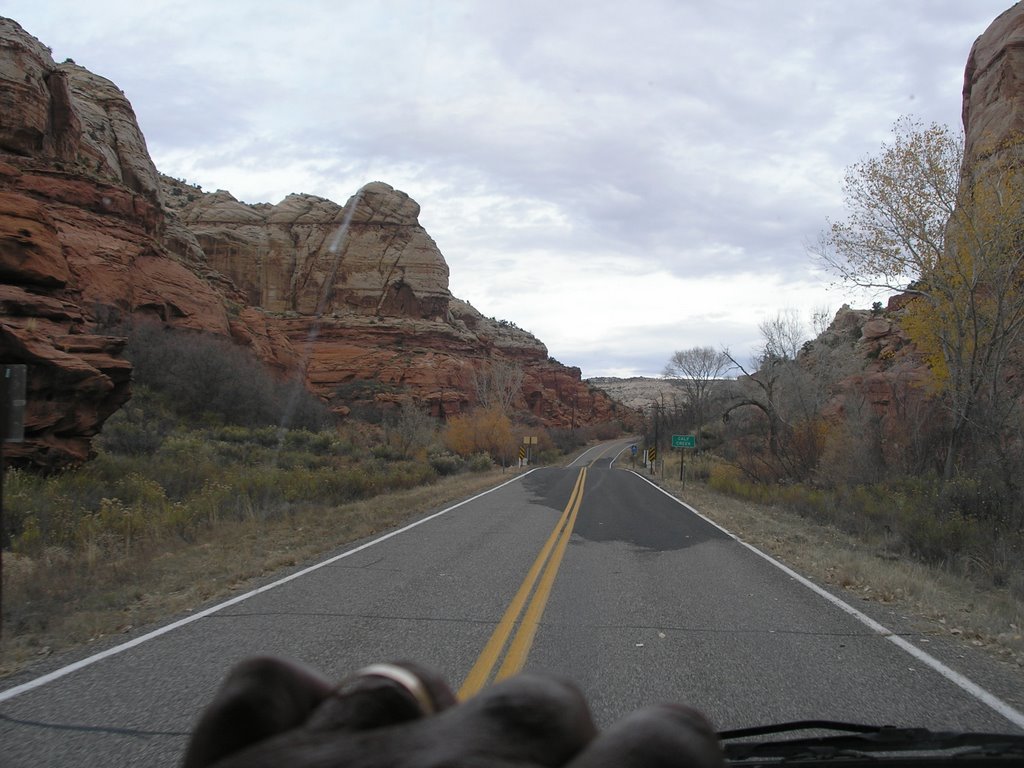
Driving in Utah From Bryce National Park to Arches National Park
It's 4 AM. I'm typing by candlelight because the campground has no electrical hookup and the RVs 'house' battery has been drained overnight. The laptop and its cellular modem are running on its own battery. It is 28 degrees F (-2 C) and the propane heater isn't working because it needs DC power to operate its computer controller. I'm afraid to turn on the van motor and recharge the house battery because there are people (hardy souls) tenting nearby and it would be inconsiderate to disturb the morning silence.
I break out the tools at dawn and replace the dead house battery with the van battery. The RV has two 'slide-outs' which give some extra square feet when parked, but you can't drive with them open. To retract the slides, I have to exchange the batteries.
We buy another battery near Bryce and in the process I meet a Mormon mechanic named Clay. Clay graduated from High School four years ago. He spent two years in Toronto on a mission to spread the word. He was a very handsome young man with sparkling blue eyes. I told him that some Mormon young people had visited me in Tampa and left me a bible. He asked if I had read it and I lied to his face. He was a delightful and friendly young man.
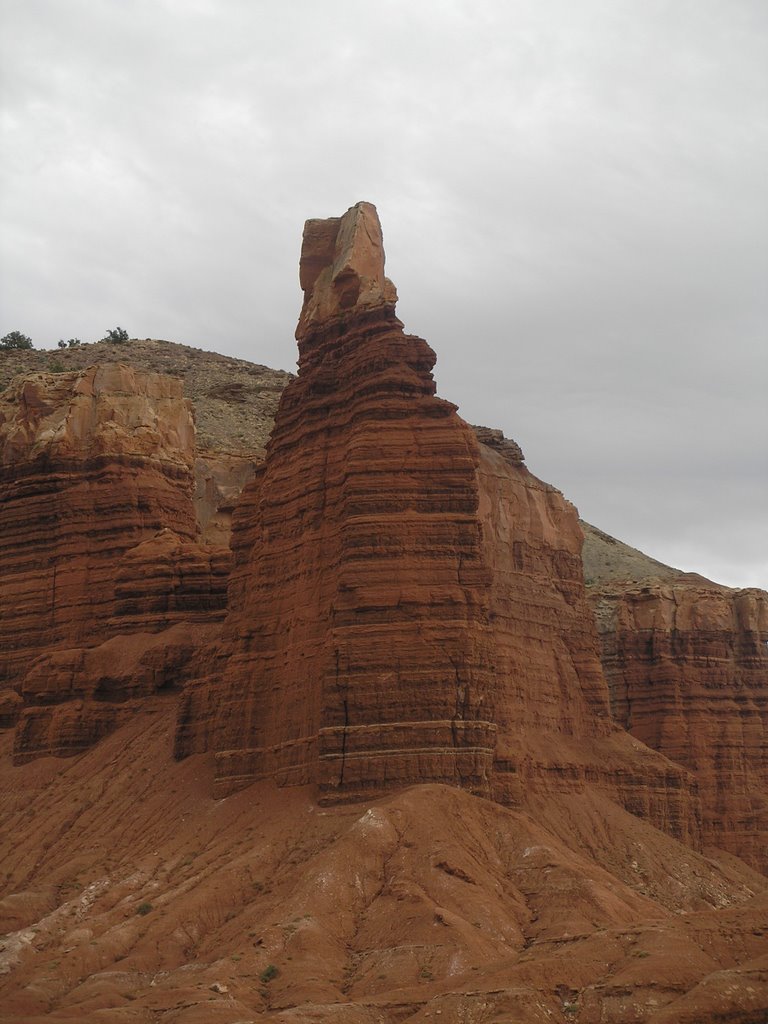
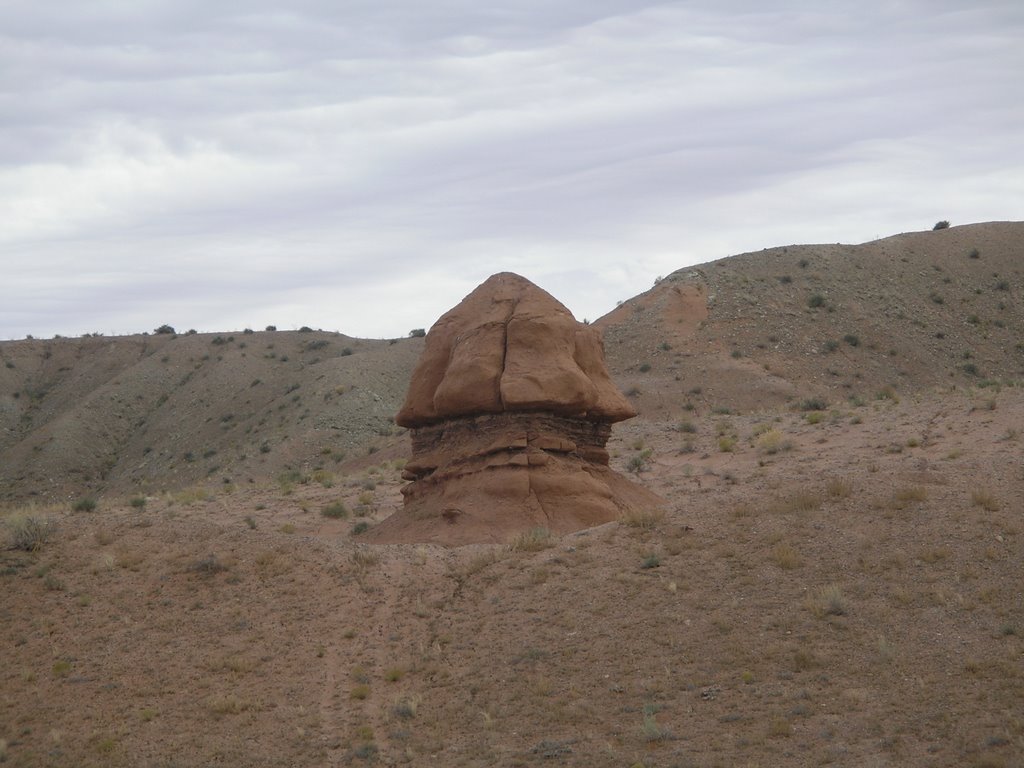
The trip 270 mile drive today leaves us in Moab, Utah. Next door is Arches National Park and Canyon lands National Park. I like this place. It has two used book stores. Today I took a bunch of casual snap Utah windshield pictures on the astounding 270 mile drive from Bryce to Moab. One geologic formation really made me laugh.