Search This Blog

Showing posts with label Mescalero Apaches. Show all posts

Thursday, 21 April 2011

Chiricahua History

Chiricahua National Monument, Arizona

We drove up to see the National Monument for the second time. Back in 2007 it was snowing and beautiful. Now it's merely beautiful.


The Chiricahua Apaches moved into the area about 1630 and ran into the Northern expansion of the Spanish. That led to centuries of conflict.


The most famous leader of the Chiricahua Apaches was Cochise. He was a brilliant leader and tactician. The Apaches were perhaps the finest foot soldiers in history, able to run all night, barefoot, in single file though the desert to attack an objective.


The rocks of Chiricahua look a little like those in the Bryce National Park. The difference is that Bryce is red sandstone and Chiricahua is compressed volcanic ash.


Cochise was born about 1815. He led efforts to repel Mexican settlers until a period of relative peace began in 1850 when the US annexed the area. He was falsely accused of kidnapping a settler’s son and imprisoned after reporting for questioning. He escaped after being shot three times. He took hostages to use in negotiations, but his plan backfired and both sides killed all their hostages. Cochise signed another treaty in 1872.


Chief Cochise was buried secretly somewhere in the Cochise Stronghold nearby. The Chiricahua National Monument is one of the mountainous "sky islands" rising out of the vast Arizona deserts.


To establish a National Park requires an act of Congress. National monuments, forests, rivers, historical sites, battlefields, etc, require only the signature of a President. This area was set aside as a National Monument in 1924 by President Calvin Coolidge.


The Chiricahua Mountains were created by a massive volcanic eruption only 26 million years ago. Thick layers of ash were compressed into rock, uplifted, eroded and fractured. The Chicicahua Apaches called this “land-of-rocks-stood-on-end”.


“I was born on the prairies where the wind blew free and there was nothing to break the light of the sun. I was born where there were no enclosures." – Geronimo


Neil Erickson fought Apaches for five years and served 30 years in the Army. Neil and Emma established the Faraway Ranch at the entrance of the Monument.


Emma lived here until 1950, when she died at age 96.


Her son, Louis Benton, "Ben" served in WWI and died at age 87. The helmet on his grave may be his, but the ribbons include a Vietnam Service medal with an oak leaf cluster, which he is unlikely to have received at age 80..


When we were here in January, 2007 it had snowed. This is a picture of the Faraway Ranch built by the Ericksons.


Disgruntled Apache warriors, most notably Geronimo, continued raids until 1886. That was the last significant Indian guerrilla action in the United States. At the end, his group consisted of only 16 warriors, 12 women, and 6 children. Upon their surrender, Geronimo and over 300 of his fellow Chiricahuas were shipped to Fort Marion, Florida. One year later many of them were relocated to the Mt. Vernon barracks in Alabama, where about one quarter died from tuberculosis and other diseases. Geronimo died on Feb. 17, 1909, as a prisoner of war.


Monday, 24 October 2005

Mescalero Apaches


White Sands National Monument, New Mexico


We left Ruidoso early today and passed by the Apache Casino on the way out of town. Indians are exempt by treaty from many state laws and tribes can operate casinos and sell cigarettes with no state taxes. These tribes once reckoned descent though women and the men religiously avoided their mother-in-laws.


About 1,700 Mescalero Apaches live on their reservation of 2,000,000 acres. There are 4,000 acres that are suited for agriculture (although Apaches have little inclination to farm) and another 500,000 acres are appropriate for grazing cattle and horses. The 25-mile drive though the reservation was not what you might expect. It is a long climb through the reservation up a winding wooded valley to an elevation of 9,000 feet. There are many small Indian ranches with lush pastures, Hereford cows and painted horses, some of which were on the road. No feathers or warrior bonnets. No marketing of trinkets. Just a quiet Sunday morning drive though lovely woodland and pasture.

The bright yellow (autumn) trees with white bark that we have been seeing are aspens, which grow at elevations above 7,000 feet. The aspen leaves shimmer in the wind like no other tree. They mix everywhere with giant pines. There is no sign of the pine beetle infestations that have killed hundreds of millions of pine trees in Alaska and in most of the rest of the US. Perhaps this pine population is isolated by the desert?

As we left the reservation, we found free municipal tennis courts in the small ski resort of Cloudcroft. I lost 6-2, 6-0. I blame the altitude. Peacocks are often unable to fly at this elevation.

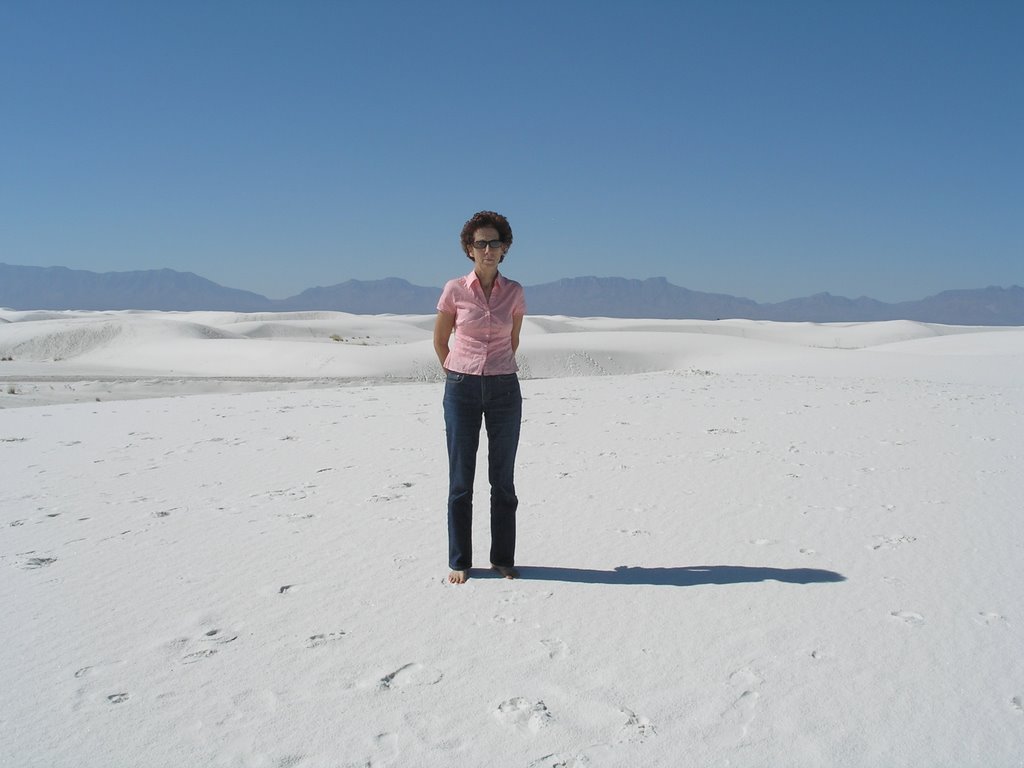
After the tennis game we ride down 4,000 feet to Alamogordo, using the transmission to conserve the brakes, and then on to the 300-square-mile white gypsum dunes of the White Sands National Monument. We tour White Sands on the motorbike and see an Apache dune mouse scurry over the road. The creatures of the desert are nocturnal and most, like the Apache dune mouse, have evolved a pure white colouring to shield them from predators. We shed our shoes and climb the dunes barefoot. As we drive 30 miles at the park's speed limit, we are continuously overtaken and passed by SUVs in a hurry to see the dunes and desert creatures at very high speed.


About 10 million years ago, the Earth's crust began to settle at White Sands along fault lines running north and south. A huge basin was formed between the Sacramento Mountains in the east and the San Andreas mountain range to the west. Melting snow washed sediments into a large lake, which became saturated with gypsum. As the climate warmed, the lake evaporated and this area began to form into the ever-changing white dunes, which are 97% gypsum.

We are settled now in Elephant Butte lake, just North of Truth-Or-Consequences, New Mexico


Sunday, 23 October 2005

Ghost Whispers

Lincoln, New Mexico

A trip to Wal-Mart for gloves and then another bike ride from Ruidoso — seventy miles to the Lincoln County Courthouse. The very small town of Lincoln is where Billy the Kid killed two guards and escaped. Ghosts whisper my fate in my ear as I walk, alone and slowly, up the same stairs as Billy to the room where he was shackled to the floor, awaiting the hangman. I look for bloodstains at the top of the stairs. Large legends for such a tiny place. It's almost unchanged since the 1880s.


This is not the dry, dusty place that one might imagine. It's rolling grassland with mountains and hardwoods that turn brilliant yellow at this time of year. The Kid was perhaps innocent, but was sucked into a feud between two rival shopkeepers. Both stores are still here like time stood still. An Irish immigrant and an English newcomer both wanted to sell cattle and other goods to the soldiers at the nearby Fort Stanton. The fort was established to control the Mescalero Apaches and make the area safe for settlement. Billy worked as a cowboy for the dead Englishman and became embroiled in the cycle of violence. The two large competing stores are still the main buildings in Lincoln, which seems to have a population of about fifty with no services other than the stores that have been made into museums.


I discuss Pat Garrett's book with the museum curator. She says it sucks and recommends Billy the Kid: A Short and Violent Life.

Near the closed fort, five miles from Lincoln, we find a lonely fenced graveyard with a large anchor. It has graves and crosses for thousands of Merchant Mariners. A sign says 'No metal detecting'.

We will be traveling though the Mescalero Apache Indian reservation on the way to the White Sands National monument, Las Cruces, Truth-or-Consequences, Elephant Butte Lake State park, Gila Cliff Dwellers National Monument and a ghost town named Mogollon. Then into Arizona.