We open a drawer and a little furry brown mouse scurries away. We open more drawers and see evidence of many mice.
We hear scurrying sounds in the roof. When we turn on the A/C, pieces of Mrs. Phred's clothing blow out of the vents. We pitch all the clothing they've eaten holes into and wash the rest.
Mice and squirrels like to chew on wires, so it's possible that the failed rear video camera and tow vehicle wiring might have succumbed to the predations of mice. I made a cod fish deep fried in beer batter last night. It was very good. We bought it right off the dock.
We place dryer sheets (the kind you add to the dry cycle for soft clothing) behind all the drawers. Mice don't like the smell and they are less obnoxious than moth balls. Mrs. Phred is upset. She's soaking all the silverware and dishes in bleach. We buy glue traps and standard mousetraps to bait with peanut butter.
We'll also leave out peanuts to see if they've gone away. One pair of mice can produce 15,000 offspring in a year. Closer inspection also reveals a large bird's nest under the RV.
It's a big maintenance day. We wash both vehicles and all our clothing and silverware (none of it is silver, really) because of the mouse turds. When you listen to the natives here, you keep hearing how the seals are eating all the cod and should be killed back. The seals themselves are underweight and subject to an exploding population because man has killed off the Orcas.
The ferry is having problems and our noon departure tomorrow has been pushed back to 7:30 PM, which will put us back in North Sydney about 1 A.M.
We've had back-to-back lovely days with blue skies and about 70 degrees Fahrenheit. Our Italian washer/dryer failed to drain today. I read the manual and found how to disassemble the machine and check for a drain blockage. I found three dollars and sixty-three cents in American coins blocking the drain. It's not that often these days that I can make big money fixing a problem.
We've found a lovely cove to spend the day. Our ferry leaves Newfoundland on Sunday. Mrs. Phred has several more places she wants to see on the drive back down the west side of Newfoundland,
Our RV park has only nine sites. It's right on the water. Cowhead has a two little convenience stores, a botanical walk that some of the local ladies were tending today and theater production each evening.
Our host has a 440 cubic inch Barracuda called "The Black Pearl". He cranks it up and drives it at 30 kilometers per hour 500 meters to the convenience store. You can hear the supercharger whine and the glass pack mufflers burble. The "Pearl" has a spectacular black metallic paint job, a big supercharger, two 4-barrel carburetors and "Hoosier" slicks on the back end. We made lovely cars once upon a time. There were no limits.
I've been very intrigued by the new Ford Mustang. It gets over 30 MPG with a 300 HP engine. They recently drove it over 950 miles on 20 gallons of gas at 48 MPH. Maybe it comes in a convertible? We need a new toad. Ours has 170,000 miles on it (towed and driven).
L'ans aux Meadows, Newfoundland As a child, they told us in school that the Vikings might have visited North America 500 years before Columbus. Back then there was no convincing proof. There were only the Icelandic “sagas” that described the Viking voyages of Leif Erickson and Eric the Red back about 1000 A.D. These sagas were passed on verbally for 300 years until they were written down by Norse Christian Monks about 1300 A.D. The search for the site described in these sagas went on for over 200 years until the mounds on the Northern tip of Newfoundland were discovered in 1960. The archeological digs here made the case that the sagas were true. They’ve done a nice job building sod huts that represent what the buildings may have looked like in the base camp established by the Vikings. The archeological explorations have discovered evidence of iron working to build ship nails, spindles from a loom and a lost bronze clothing pin that nails totally down the Viking connection. They also found well preserved wood shavings in workshops where boats were constructed.
A beautiful river runs though the Viking camp which must have contained the bountiful salmon described in the saga. They can’t do dendrochronology because the area has been largely deforested over the years for firewood. However, with carbon dating they are pretty sure that the camp was established about 1000 A.D. (plus or minus 2 years) and was a going concern for several years.
They say that Greenland is only 650 miles from here as the crow flies. The Vikings probably took about 35 days to make the trip. They navigated about 1,300 miles by always keeping land in sight so they probably went from Greenland to Baffin Island to Labrador to here (the Northern tip of Newfoundland). The saga is consistent with geological features of Baffin Island and Labrador.
There is the natural wild wheat described in the saga, the river for salmon, the peat to build shelters and iron and coal. It’s a good place for a base camp. When the Vikings left here they burned the buildings which were made of peat over wood frames.
When you look at the mounds, you can easily imagine the Vikings forging iron, weaving wool, building boats, catching salmon and burning seal oil in smelly, smoky lamps. I’m convinced that this is the real deal. The voyage was as epic as the first landing on the Moon.
L'ans aux Meadows, Newfoundland
We drove all day though fog and rain to reach the Northern tip of Newfoundland. More than 1100 years ago my Viking ancestors established a settlement here in North Anerica. They called the place Vinland because of the wild grapes. The dig is about 2 kilometers from our campsite.
I have a recessive disease calledDupuytren's contracture, which is also called "Viking's disease". This causes my fingers to curl up so it's hard to grasp my tennis racket or put my hand in my pocket. About every three years I have my fingers surgically straightened. I'm lucky. Sometimes it also causes one's penis to curl up.
We're wondering how exactly they have this archeological site dated. The trees here are not long-lived, so dendrochonology may not be all that helpful. I read that they have done some carbon dating on the site, which is not that precise.. However, the bronze and iron artifacts they've recovered leaves little doubt that Eric the Red spent some time here.
We'll visit the digs in the morning and report our findings. Forget Columbus day. This is the real deal. My quivering, curled fingers tell me that my European ancestors were here first.
We're on the west side of Newfoundland, about 240 miles north of the ferry port. It's an approximately equal distance north to the short ferry over to Labrador.
Last night we had planned to go to a pub for mooseburgers and music. Newfoundland has the highest concentration of moose in the world. There are four moose per square kilometer in moose suitable habitat. These all came from four moose imported here about a 100 years ago. We haven't seen any yet. When we arrived at the pub we found that it required tickets and was sold out (filled with old people from an RV caravan). We found a little local restaurant that served us white wine and a lovely deep-fried codfish. I plan to eat more cod in the future.
The Western Brook Fjord is a narrow channel carved by waves of glaciers in billion year old igneous rock. The walls reach a height of 2,000 feet even after a billion years of being ground down. It is believed that about 40 glaciations have filled the fjord only to eventually retreat. You reach the boat tour of the long fjord by a 3 kilometer hike though bogs and marshlands. The blue star iris very common along the trail this time of year.
The last glacier melted about 15,000 years ago. At first it was a true saltwater fjord, but it became landlocked about 9,000 years ago when the land near the sea rose again after being relieved of the weight of billions of tons of ice.
The fjord is now fresh water, oligotrophic and distinguished by nutrient deficiency, as opposed to productive, eutrophic lakes, with an ample or excessive nutrient supply. Oligotrophic lakes are most common in cold regions underlain by resistant igneous rocks (especially granitic bedrock). These lakes are oxygen rich. The water of Western Brook is so clear and pure that it is a poor conductor of electricity.
Mrs. Phred has been lugging these geraniums around since May. They go into the sink when we travel. They seem to like the alternating days of wet weather and then long hours of sunshine.
We found a place in Rocky Harbor to buy fresh fish right off the boat. This morning we take a hike of about an hour to a boat on a "pond" in the park. The pond is about 12 miles long and has cliffs that rise vertically to about 2,500 feet above the pond. We saw a wolf run across the road right in front of us on the way home yesterday. No moose yet.
I'm really getting annoyed about pipe tobacco prices. Here in Newfoundland the price is up to $28 an ounce, which is enough for three days. My annual budget for tobacco is being totally fractured by this visit to a "nanny state" which requires a helmet to ride a bicycle and thinks smoking is possibly harmful to one's health (and a drain on their health care system).
I think maybe a week might be enough of Newfoundland. I'm about ready to return to our native land. Maybe I'll find something to do back in Florida this winter (improve my tennis, learn a new language, fix up an old house, brew some beer, make wine, write the great American novel) ...or maybe not.
This bus pulled into the campground yesterday. Each of the windows is a sleeping compartment for a German tourist. The compartments are 3x3x6. The Germans get off the bus and each seems to have an assigned task, which they efficiently complete (take a shower, get firewood, set up the kitchen). The buses are run by Rotel Tours. We saw one in a Alaska a few years ago and didn't quite know what to make of it.
We'll be here in the park two more nights. Maybe some hiking tomorrow and than another decision (north, east or south)...west is not an option because of the ocean. Only six icebergs have showed up this year compared to 180 in 2009. The single channel on TV talks about the possible adverse effects on tourism...but we've seen our fair share of bergs.
The ferry ride to Newfoundland was quick and luxurious. We skimmed along at 26 knots, running on all four engines for the five hour trip...
They had a bar, a good restaurant, computers, casino, a game room and a theatre. Our RV park was 28 kilometers north of the terminal. We arrived in the dark and fog and reset the odometer to zero, looking for our new home to show up at about 18 miles.
We found our home in the forest on a lonely stretch of highway 28 kilometers north of the ferry port. Our RV was invaded by dozens of little flies while we set up in the dark.
Yesterday we toured the Port Au Port peninsula, about a two hour loop.We stumbled
upon the crash site of an American C-54 which hit a 1,000 foot mountain on November 12, 1944. Several of the soldiers aboard were killed on impact but a few survived. Mrs. Phred want to stop to take pictures of these furry creatures...we're not sure how Alpaca is spelled.
One of the survivors was found by a fur trapper and they went into a village that had a telephone. Several more of the survivors died in the hospital. You can sort of imagine heavy fog or snow and a bunch of soldiers and civilians (OSS?) on the way to England looking to refuel in Newfoundland. Some of the cottages here have odd yard art...we think it might be some sort of obscure French-Canadian thing.
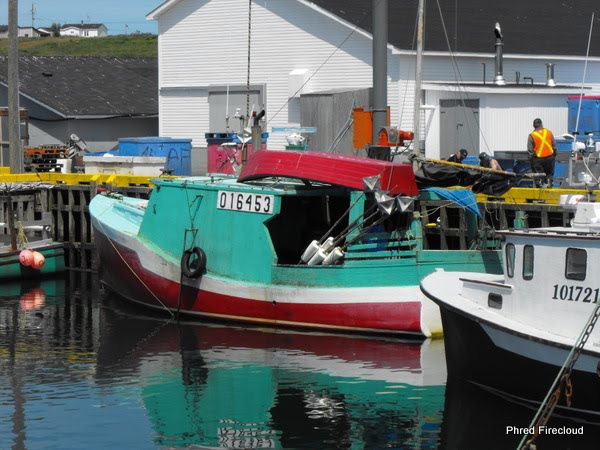
We drove out on a promontory on a gravel road and found a lot of lobster traps, fishing cabins and lobster boats at the tip after about 20 miles of bumpy travel. We move on to GrosMorne National Park this morning.
 We open a drawer and a little furry brown mouse scurries away. We open more drawers and see evidence of many mice.
 We hear scurrying sounds in the roof. When we turn on the A/C, pieces of Mrs. Phred's clothing blow out of the vents. We pitch all the clothing they've eaten holes into and wash the rest.
 Mice and squirrels like to chew on wires, so it's possible that the failed rear video camera and tow vehicle wiring might have succumbed to the predations of mice. I made a cod fish deep fried in beer batter last night. It was very good. We bought it right off the dock.
 We place dryer sheets (the kind you add to the dry cycle for soft clothing) behind all the drawers. Mice don't like the smell and they are less obnoxious than moth balls. Mrs. Phred is upset. She's soaking all the silverware and dishes in bleach. We buy glue traps and standard mousetraps to bait with peanut butter.
 We'll also leave out peanuts to see if they've gone away. One pair of mice can produce 15,000 offspring in a year. Closer inspection also reveals a large bird's nest under the RV.
 It's a big maintenance day. We wash both vehicles and all our clothing and silverware (none of it is silver, really) because of the mouse turds. When you listen to the natives here, you keep hearing how the seals are eating all the cod and should be killed back. The seals themselves are underweight and subject to an exploding population because man has killed off the Orcas.
 The ferry is having problems and our noon departure tomorrow has been pushed back to 7:30 PM, which will put us back in North Sydney about 1 A.M.
 We've had back-to-back lovely days with blue skies and about 70 degrees Fahrenheit. Our Italian washer/dryer failed to drain today. I read the manual and found how to disassemble the machine and check for a drain blockage. I found three dollars and sixty-three cents in American coins blocking the drain. It's not that often these days that I can make big money fixing a problem.


