Search This Blog

Thursday, 6 June 1985

The Rolls Royce Silver Cloud

West Palm Beach, Florida

The "Owens" is a sunken freighter off West Palm Beach at about 110 feet. Someone has dumped a 1965 Rolls Royce Silver Cloud next to it to enhance the dive. The gulf stream is very strong here, maybe three knots.


In other dives, in the Bahamas, the divemasters sometimes joke that there is a Maserati, Hummer or perhaps an Aston-Martin DB5 on the ocean floor and everyone always laughs at these tired jokes.


I'm doing the dive on the Owens as part of my "Rescue Diver" certification with a "buddy", Alan. As rescue divers we are required to check the gear of other Divers. Alan "checks" my air valve and turns it off completely. There are strong Gulf stream currents in Palm Beach so to hit the dive target (Owens) we need to be overweighted and go down really fast. I'm down about 15 feet and dropping like a stone when my air cuts off completely after an exhale. I kick hard to the top, feeling betrayed. From here on when someone attempts to touch my air valve I ask them if they really want to keep that hand and reach for my dive knife. Also, I always take three breaths before jumping in while watching the air gauge to see if the valve is really on or if maybe I'm just breathing the systems pressurized air from the last time the valve was on.


I don't look for Alan as I go back down to the wreck. The wreck has huge schools of swarming fish and predators like Jacks trying to pick off strays. Stonefish on the bottom are poisonous and virtually invisible. The Gulf Steam current is ripping though the wreck. The Rolls Royce has definitely seen better days.


It's twightlight and approaching night. At 100 feet down it's getting dark. In our dive briefing they say emphatically "do not penetrate the wreck." Therefore, I hide a flashlight in my dive gear and quickly swim into the hold and then into another three by two foot opening in the freighter hold when I see no one is looking.


When I come out of the long small shaft I had used to enter the Owens I find myself in a small room leading to other rooms with steel bunk beds, lockers and many protubances that are snagging my airhoses and making me feel a little claustrophobic. It's really dark inside the wreck. I can only see with my underwater flashlight. I think of EverReady battery commercials. When I touch things, clouds of particles swirl up to obscure my vision within the ship's compartments. Sometimes I'm in complete blackout conditions.


I'm down to my last ten minutes of air at 110 feet and alone inside the Owens, I decide it's time to leave. When I return to the entrance area in the room that I had entered, I see that there are four identical 3x2 shaft openings leading to unknown places. One of them would have taken me back the way I came in. It's hard to know where the other three 3x2 shafts would go.


I am very amused by this situation for a moment, get an adrenelin rush and then begin to imagine old 1960's Lloyd Bridges TV "Seahunt" sound tracks where the music gets very loud once the diver runs into bad trouble. I begin to laugh and bubble which hard to do with a regulator in the mouth.


I take a another minute to look around and up and down and notice a shimmering square from the last of the daylight two stories above me where someone had cut a nice 3x3 hole in the side of the Owens to keep stupid people from getting stuck and lost. "How Thoughtful!", I think and then begin slowly rising to the surface, carefully avoiding the "bends" or a nasty air embolism.


The sensation of running completely out of air after completing an exhalation while dropping like a stone is not one I'm ever going to willingly repeat. Alan did ask me, back on the boat, where I went. I told him about running out of air and explained the correct air valve loosening procedure..."righty-tighty, lefty-loosey". I didn't tell him about penetrating the wreck. He could easily have killed me, but he was always well intentioned. What I learned from Alan was to take two breaths from the regulator, before jumping in, while watching the air pressure gauge...if the air valve is actually off the needle drops about 1,000 PSI per breath.


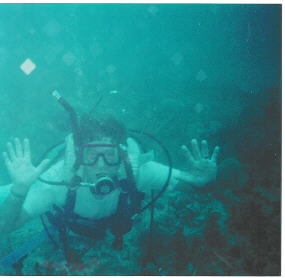
Saturday, 7 July 1984

H.M.S. Diamond Rock

Martinique - July 18, 1984

H.M.S. Diamond Rock is 600 feet high. It looks like the top half of a large green granite cabbage off the Martinique coast. The rock was once occupied by the British who hauled cannons to the top. Admiral Hood commissioned it as a sloop in an impressive display of non-linear thinking. Strangely, the small island is still registered by the Admiralty as a British warship. The French defeated the British forces by floating a wreck with a number of barrels of rum up to the rock. They then proceeded to liberate the island fortress in a bloodless victory 12 hours later.


My wife and son went there with me for diving. They both passed on the big trip to the rock. Our modern American gear didn't mate up with the French air tanks so I had to use their primitive equipment with no depth gauges, compasses or spare regulators.

In spite of my American Divemaster certification, I had to learn and demonstrate French diving hand signals to be permitted to sign up for the dive. They told us that we would be going into a beautiful cavern. One rule they had that was "special" was that it was not permitted to surface if we ran out of air. Instead, we were required to swim to the group leader who had extra regulators and two tanks and ask him for permission to breathe his spare air.


We departed to dive the H.M.S. Diamond Rock on an old Chris Craft. A young Frenchman was the Captain. He lived on the boat with his wife and his baby.

The Diamond Rock cavern is shaped like an acute triangle with the apex only about 15 degrees, the floor is about ten feet across and the walls generally are about 30-40 feet high. Prolific sea fans and corals make the cavern itself beautiful and interesting.

A cavern is generally defined in the diving world as an enclosed space where you can always see at least a little daylight no matter how far in you go. A cave, by contrast, allows a diver to go deep enough to encounter complete darkness on sunny days with good water visibility conditions. There is a cavern in Florida, spring-fed, where you can go in 300 feet, turn off your flashlight and still see the entrance glow. I don't do caves and have no interest in becoming cave-qualified.

Cave divers are a strange bunch. They lay down line to find their way out, carry three lights and are trained to begin their exits after using 1/3 of their air. In spite of that a number of divers drown in Florida caves every year...one young man took his last minutes to scratch "love you mom and dad" on his tanks...what a waste.

I get a little antsy even in caverns because you can't just go straight up in an emergency swimming ascent when things go wrong.

The cavern was very spectacular. It was formed when a huge slab of granite rock fell down millions of years ago (or at least a while back). The cavern walls were covered with beautiful corals and sea fans. The current blew us in quite smartly for about 75 yards. Then we turned around. Progress back was very difficult and slow because of the apparently unanticipated strong current blowing into the cavern. I pulled myself hand-by-hand along the floor of the cavern because it was impossible to make progress swimming. This hard work and the strong current caused me to nearly deplete my air supply before emerging....my entire dive party left me behind in a frenzy of panicky swimming activity and they all ran out of air in the cavern and then attached themselves to the "dive leader" who had two tanks. Because I pulled myself along the floor, in addition, to gently kicking, I emerged later with precious little air to spare and nowhere to go but up. It was my favorite dive out of the maybe 1500 I've done.

When I came out of the cavern and could again see the blue sky overhead, the two other divers with me had both run out of air in the cavern and were breathing off the group leader's two regulators. The group leader was actually breathing from his buoyancy control exhaust hose (a trick I never learned in my advanced courses). I swam over and showed him that I only had 200 pounds of air left and made the proper American signal (the bye-bye fluttery wave) for "I'm getting the hell out of here, you idiot!". I swam slowly to the surface to avoid embolisms without asking for any further permission, in complete violation of the dive rules.

On the way back, the young French Captain blew what appeared to be about two bottles of fine red French wine in the most perfect display of projectile vomiting I have ever seen. A colorful end to a perfect dive.


Wednesday, 8 April 1970

A Thousand Slimy Things Lived On...and So Did I

Midway -1967-68

Midway Atoll has changed from a source of guano. to a 1930s Pan-Am refueling stop, to a WWII critical battle site, to a Vietnam refueling stop for military aircraft, and then to a U.S bird sanctuary.


There are currently 400,000 nesting pairs of Gooney birds (Albatross) on Midway, about 70% of the world population. The birds arrive in August and stay until late Fall. The mating ritual involves throwing back the head, flapping wings, and yodeling in perfect synchronization for days on end. They are graceful in flight but ofter suffer midair collisions.  They frequently crash and tumble on takeoff rolls and on landing. They won't move from the nest if approached by humans or vehicles.

 Overhead the albatross
Hangs motionless upon the air
And deep beneath the rolling waves
In labyrinths of coral caves
An echo of a distant time
Comes willowing across the sand
And everything is green and submarine. 
-Pink Floyd


I stayed in this barracks some times after a 10 hour, 2,300 miles, flight from Japan. The Navy was our host and we showered and brushed our teeth in saltwater. I often had diarrhea here and first thought it was the water until someone told me that it came from eating raw snakes and eels days earlier in Okinawa.

The birds have to be in sync because they take turns shielding the nest from the sun, which kills many of the baby chicks every year. Up to 1,000 a day die in the hot sun and are hauled off to the incinerator....it is survival of the fittest...mother nature takes her toll.


Midway was the turning point in the Pacific war. The U.S. sank four Japanese heavy carriers here with great losses of their best pilots and airplanes. Japan never recovered from these losses. U.S. Navy code breakers allowed the Navy to learn the exact date (June 2, 1942) of the attack on Midway and position an inferior force to lie in wait.

For reasons not entirely understood the wandering albatross have a deferred mating pattern and does not return to Midway to mate until they are 8 or nine years old. Recently, a bird tagged in 1958 returned to mate which says something about lifespan.

 
The Breaking of JN-25
Breaking the Japanese code known to Americans as JN-25 was daunting. It consisted of approximately 45,000 five-digit numbers, each number representing a word or phrase. For transmission, the five-digit numbers were super-enciphered using an additive table. Breaking the code meant using mathematical analysis to strip off the additive, then analyzing usage patterns over time, determining the meaning of the five-digit numbers. T

AF Is Short of Water
In the spring of 1942, Japanese intercepts began to make references to a pending operation in which the objective was designated as "AF." To alleviate any doubt, in mid-May the commanding officer of the Midway installation was instructed to send a message in the clear indicating that the installation's water distillation plant had suffered serious damage and that freshwater was needed immediately. Shortly after the transmission, and intercepted Japanese intelligence report indicated that "AF is short of water." Armed with this information, Nimitz began to draw up plans to move his carriers to a point northeast of Midway.

The Gooney Bird's long wings are ill-suited to powered flight and most species lack the muscles and energy to undertake sustained flapping flight. Albatrosses in calm seas are forced to rest on the ocean's surface until the wind picks up again. 


I logged 2,800 hours of flying time at this C-124 navigator's station.  There is a lot of primitive WWII era gear here, including the APN-9 Loran A oscilloscope and a crappy radar. The best navigation aid was a dead reckoning, followed by the bubble sextant.

The maximum takeoff weight of a C-124 is 197,000 pounds. Once, one of my pilots, wanting to fly 3,300 miles to Tacoma, had the empty airplane refueled to 110 percent of the allowable maximum weight. We took off in the pre-dawn darkness, lumbering slowly to the very end of the runway and lifting off into the darkest night I can remember about five feet above the ocean. It took what seemed forever to get high enough that dipping a wing into the water was no longer a possibility.

 When taking off, albatrosses need to take a run-up to allow enough air to move under the wing to provide lift.


The C-124 was designed for 5,000 hours of flight time but often hit 50,000. It had the largest piston-driven engines ever mounted on an airplane. The wings developed cracks and sometimes broke off in heavy turbulence. The last one was retired from the National Guard in 1974.

Gooney birds have been recorded flying non-stop over 4,000 miles to find food for the chicks. It's possible that the strenuous mating dance, which lasts for days, is a survival mechanism. The birds have to each be fit enough to share gathering food and sheltering the nest for months.


Above is a picture of Midway on December 7, 1941, after a sneak attack.

The picture below is the flight engineer's station on the C-124. They would do things like throws the levers to kick in the superchargers if we had to climb above 8,000 feet to get over a mountain range.

When a bird first returns to the colony it will dance with many partners, but after several years the number of birds an individual will interact with drops, until one partner is chosen and a pair is formed. They then continue to perfect an individual dance language that will eventually, be unique to that one pair and last for life.


Young Phred Firecloud, the navigator.


Midway Atoll is about 1,200 miles from Hawaii. The atoll was formed about 28 million years ago by a volcano. The atoll is over the same hot spot that formed the Hawaiian Islands. The volcano gradually sank under its own weight, but the coral growth kept the atoll above water. This subsidence process is called an isotonic adjustment. The atoll was claimed by Captain Middleton for the U.S. in 1859 under the 1856 Uninhabited Island Guano Act.


Things change fast on the human scale of time, from the Battle of Midway to a bird sanctuary in my lifetime.


And I had done a hellish thing,
And it would work 'em woe:
For all averred, I had killed the bird
That made the breeze to blow.
Ah, wretch! said they, the bird to slay,
That made the breeze to blow!

The many men, so beautiful!
And they all dead did lie:
And a thousand thousand slimy things
Lived on; and so did I. 
Rime of the Ancient Mariner
Samuel Coleridge