Ken and Karen invite us to go sailing with them one last time this season.
We drive to the Pink Elephant in Boca Grande. They meet us on the dock with their rubber dinghy and transfer us to the Coyote.
Boca Grande means "big mouth" in Spanish. It's an upscale community on Gasparilla Island.
We have lunch on cabbage key. I order a Reuben sandwich and am pleasantly surprised to find that they substitute grouper for the pastrami. The ceiling has about $70,000 in currency attached by customers with scotch tape.
The area was inhabited by Calusa Indians from about 5,0000 B.C. By the mid-18th century, the Calusa had all but disappeared, the victims of European diseases, slavery and warfare.
Gasparilla Island and the big Gasparilla blowout in Tampa are both named after the legendary pirate, Jose Gaspar. Jose died in 1821 after many daring exploits. No trace of him appears in writing until about 80 years later. Some feel this calls his actual existence into question.
Ken is towing a dinghy for the first time. The noise it makes as the waves lap against the hull bother him a little. He like the silence of sailing quietly to and fro, going nowhere slowly
Boca Grande is best known for Tarpon fishing. Tarpon are large fish that fight fiercely. They are not good to eat so it's a sport that pretty much involves pure animal abuse. About 5,000 Tarpon a year are caught and released here (worse for wear).
We pass a pod of porpoises lat in the day and then say goodbye to Ken and Karen until perhaps next fall...
Search This Blog
Showing posts with label Boca Grande. Show all posts
Wednesday, 8 April 2015
Thursday, 3 April 2014
Gunkholing in America
Lucky Me
Ken invited me to go on a four day sailing trip from Sarasota down to Boca Grande on Florida's west coast.We meet a few days in advance to discuss what to bring: fins, mask, venison steaks, potato chips, kayaks and so on.
Gunk holing in a sailboat is like boondocking in an RV. You find a nice place to drop anchor and spend some time.
The first day we head south on the intercoastal with winds from the north at 20 knots. There are bridges about every three miles. We call them on the VHF and they stop traffic to raise the bridges...."Burnside bridge, this is the American Dream....requesting opening...we have a yellow jib...heading south"...
Unless you make this trip in a boat it's hard to imagine the wealth lining the intercoatal.
We see a lot of ospreys on the way down.
The first day we travel about 40 miles in ten hours and spend the night gunkholing near Stump Pass. Ken let's me steer the boat for awhile until I run aground in 3.5 feet of mud...
On day 2 we sail out of Stump Pass to the Gulf of Mexico and on down to Boca Grande, which means "big mouth" in Spanish. Boca Raton means "mouth of the rat".
We decide to hike in the Cayo Costa state park. It's a big park of lovely barrier islands which is only accessible by boat...I feel like a member of the one percent as we explore and take a five mile hike.
We see that the prickly pear cactus are in bloom.
I think of these as "morning glories" but they might be something else.
You can't beat Florida beaches...they go on forever...
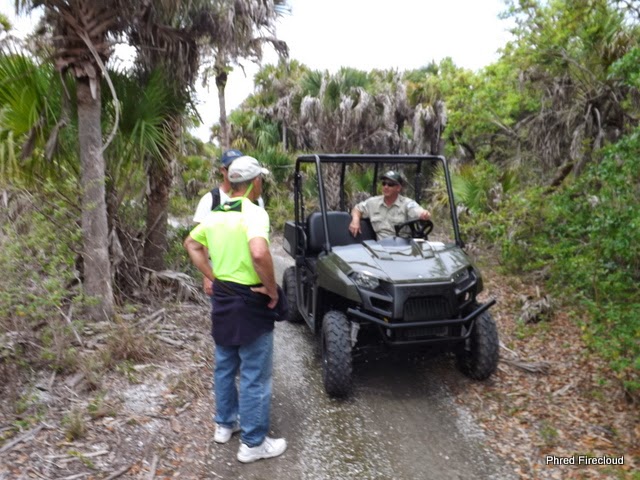
Gary queries the ranger about the wildlife. There are alligators and two bobcats here. Lots of armadillos.
The old cemetery has this grave from 1943 surrounded by conch shells....that's when I was born and this guy checked out...
Ken and Gary caught a crevalle jack and a bunch of trout that we had for dinner and breakfast....fresh fish...yum!
Gary stalking trout.
Sunset in the Pelican Bay gunkhole...the stars are beautiful and the anchor lights of 40 sailboats are like nothing I've seen before...
Ken teaches me how to reef the jib and raise the mainsail....
Another boat in the Pelican Bay gunkhole at sunset.
Wind the rope three times clockwise and then crank up the mainsail....
Cabbage key...
Our captain...Ken lea us on a two mile kayak trip though mangrove canopies to a largely deserted white sand beach...I regret not havingbrought my camera...watching the tidal currents flow though the mangrove roots you can see why they are are so productive of fish...
Subscribe to:
Posts (Atom)